Carolyn Sansom Caerdydd ~ Cardiff. As told to Kitty Parsons
We asked Carolyn about her journey to Quakers and she described it as ecumenical “I was enrolled in the cradle roll of the Presbyterian Church, confirmed in the Church of Wales and went to Catholic convent school from the ages of 10 - 18.”
In her late twenties, (1987) she was studying at Cardiff University. On her women’s studies course she was inspired by a lecture on 'Seventeenth Century Women Prophets' given by our Friend Christine Trevett.
That introduction to Quakers she describes as,” affirming and informing my feelings of discomfort with the patriarchal nature of the established churches.” She goes on to say, “It was a great joy to learn of women in the past and present who had tried and were trying to make women’s' voices heard and accepted.”
Carolyn had stopped going to church by 1990 but missing a faith community to belong to, she started attending Cardiff Meeting. I felt immediately welcomed and 'at home.' She says, going on to describe her father’s telling her previous rector that she had, ‘turned into a Quaker’. “I think Dad's comment neatly sums up my sense that Quakerism is the prism through which I see and experience the world. It informs my values and theology and provides the faith communities that sustain me.”
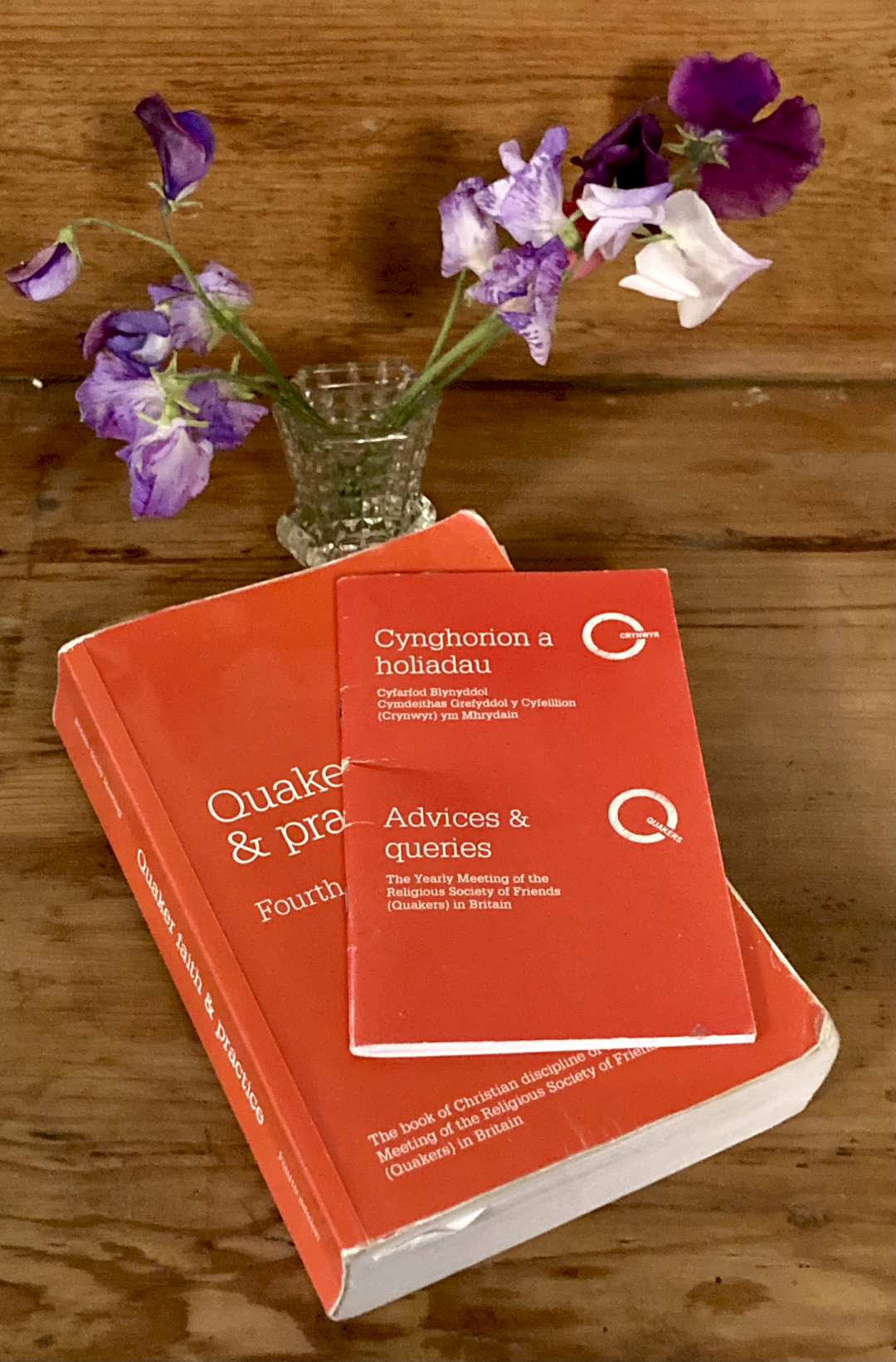
Carolyn accepts that no path is without challenges and quotes the words of Parker J Palmer in 10.19 in Qfp that have often rung true with her, that: '....our companions will be given to us by grace.'
Now in retirement, Carolyn devotes quite a lot of time fulfilling the roles she has taken on:
“In the past it has sometimes been difficult to fit Quaker commitments in with full time work in NHS mental health services and latterly caring for my aunt and mother. However, having a focus other than work or caring commitments, especially learning of the inspiring lives of past and present Quakers and having spiritual resources to draw on (such as Experiment with Light) enabled me to continue with my employment and caring responsibilities.”
She describes Quakerism as a bedrock on which she organises her life and says that Meeting for Worship continues to re-charge her spiritual battery.
She says "From the beginning I was encouraged to attend Area Meeting and so fairly quickly I felt I was part of a wider circle of Friends. Attending Meeting of Friends in Wales (now Crynwyr Cymru-Quakers in Wales) and Yearly Meeting came later. By attending Area Meetings and Cardiff's Meetings for Worship for Business helped my early understanding that, for our communities to thrive, we all need to play a part in their functioning. I was encouraged to think about applying for membership by the Elders in Cardiff Meeting. Section 10.34 of Qfp by Jai Pennar has since come to summarise why I applied for membership in 1993 'If the Society can be thought of as a ship, I would like to be one of the crew, not a passenger, and to be seen like this.
Carolyn goes on to say that she found the process of applying and being accepted in membership, most affirming and adds that she recognises, in the intervening years since she applied, that the issue of membership has become more blurred. I think we need to have honest and respectful conversations about this. Perhaps the analogy of a ship and its crew is no longer a helpful one? Carolyn notes that "the issue of membership is being discussed at Yearly Meeting and we are encouraged to participate in the process of discernment individually and within our Meetings. I hope that this discernment enables more people to come into membership and that they feel affirmed by doing so.”
Carolyn has never taken her service lightly. She says “Like many Friends, I have given (and give) service in many roles at Local and Area Meeting level, to CCQW and our Central work. Each time when a Nominations Committee has approached me for service, I've hesitated and thought that role being suggested was beyond my capabilities. However, my experience has been that the words of Qfp 3.12. referring to the service of clerks, can be widened, '...if the [clerk's] service is under concern in the certainty of God's presence and help in the meeting, then strength beyond her or his normal powers will be given.'
Giving service has tested her abilities, but has also introduced her to some wonderful Friends, increased her understanding of Quaker theology and of the structures that support Quaker work and communities. She adds “It has helped me to grow in my faith and practice.”
Carolyn’s mum died in October of 2025, and she is now in the process of making a new home in Rhiwbina, Cardiff.
“I feel very blessed, she says, “I am processing the grief of her death and that of my aunt in 2022, and pondering the mix of emotions brought about by caring for those two women who played such central roles in my life. I wonder if we can do more to support each other with caring responsibilities and grieving?
If others have ideas I'd be pleased to hear about them, perhaps over a coffee sometime.”

Kitty talks to Barry Edwards
Why do so many of us come to Quakerism later in life? It was a meeting to do with my sons’ school which just happened to be in Friends meeting house that drew me. It felt like a very special place and I wanted to know more.
I have asked a number of Friends over the years what has drawn them onto a Quaker or other spiritual path. When I asked my old mate Barry Edwards who lives in North Somerset what had attracted him to The Society of Friends, he delighted me by responding so fully.
From early school days Barry says he was really interested in R.I. (Religious Instruction) at school, but it was when he was hospitalised with TB aged 9 he felt that, in his words, “ He completely believed in God.”
He goes on say, “My family were not church goers apart from the usual, weddings, funerals, and christenings. We were a very poor family and it looked to us that the people that went to church were also the same individuals that went to the tennis club. They were certainly not our type.”
Barry first encountered Quakerism while helping to run a soup kitchen for homeless individuals at Friends Meeting House in Weston super Mare.
“It was run by another charity who rented the space two evenings each week. The posters on the walls of the meeting house drew me in, and I needed to find out who these strange folk were as they seemed to “speak to me”
Barry attended for around two years and helped with looking after the Meeting House and renters. “ I eventually took over as lettings officer, though I hate that word, “Officer”
“Quakerism has allowed me to look at the world through the testimonies and the reading of Quaker books “with a tender hand” for example.”
Are there any challenges that you find to your way of being in the world and Quaker testmonies? For example, Quakers are usually considered to be pacifist. In a seemingly increasingly divided world how does that resonate with you?
“As Quakers we are told to follow the testimonies, however, global conflicts often mean we take sides, Ukraine, Israel Palestine, Yemen, climate change, Trump all of these and more can produce tensions. For me, these global events should come under “Conflict Resolution” I find it challenging to present an alternative point of view to a group that are heavily invested in protest rather than solution.”
I find Quaker life very rewarding, treating people equally, telling the truth and working for peace is rewarding, but it can be a struggle to find simplicity in a world that is now so complex.”
What roles have you taken on at your meeting? There are usually lots of jobs for Friends to do and never enough people to do them.
“At my meeting in Weston super Mare, I am the lettings Officer, a Trustee for the North Somerset Area Meeting, and a Chaplain at North Somerset Court system.”
Sounds busy.
“Quakers are urged to ‘Live Adventurously’ but I also think we need to advertise ourselves more, we are a great group of individuals.”
Kitty Parsons Preseli

Can it be 20 years since I first went to a Quaker meeting? I had worked with one of the Milford gathering on a major environmental project so I eventually found myself nervously attending the purpose built meeting house in
It was an uplifting experience. The people were friendly and, I soon discovered, tolerant of my inconclusive ideas. I have recently read that early were associated with Seekers or Protestant free thinkers.
After a gap of some years, during which my circumstances changed, I could no longer make the 15 mile journey, I found another welcoming local group that holds zoom meetings.
I like the contemplative silence of group meetings and the supportiveness of it's members. There is no pressure to turn up, and people attend if and when it suits them. Quaker tolerance extends to cover a Universalist sub group for people who have modern spiritual ideas, and even an atheist sub group, though the basis of many or most members beliefs are traditionally Christian.
Alan Dearing Preseli

At age 16 I started a spiritual journey and attended a few places of worship including a Quaker meeting. I was uncertain of my direction but had well-formed set of values that didn't seem to fit membership of churches. Though I had a deep respect for the teaching of Jesus it was accompanied by a healthy scepticism of the teaching of Paul and so found churches inconsistent, muddled and staid. I never could get past the shift from 'you should' to 'everyone else should' approach to leadership, guidance and teaching so a state religion, state church which then 'enforced' Christianity seemed incongruous with the urge of the man Jesus, that an individual consider their own path and relationship rather than judging the paths of others.
I called myself 'Jesian' most of my life and actually did bible studies and bought and immersed myself in a red letter bible. Then A levels, social awkwardness, itchy feet and joining the Royal Navy, where I encountered and respected the Royal Sailors Rest Christian fellowship at or near bases. An injury put pay to that career choice and then my journey took me into social work, particularly Disability and more recently End of Life palliative support. All these life junctions included an awareness of spiritual 'discomfort'.
The meeting house in Stevenage Herts was a welcome refuge and Sunday home during my social work training and I became a member. I moved to join North London (Bunhill Fields) and now have returned home to Wales. The souls I have encountered on the Quaker path enriched my life and have been as autumn colours of reds and gold. I have returned to South Wales meeting and am seeking to participate in my local meeting near Narberth. Also I am privileged to serve as Treasurer to Quaker Disability & Equality Group.
The shared silence of meetings in the Society of Friends is incredibly meaningful to me. I feel that prayer, contemplation, mutual upholding and all manner of unconditional positive regard for others is my spiritual home. Allowing an individual to find their own path and to shed the limitation of doctrine and rulebooks. Managing the silence is a complex experience at times but I've learned the waves of business and worry I bring to meeting eventually wash up on peaceful reflective shores often guided by inspired ministry.
Latter years have seen my journey encounter 4 consecutive cancers and feel somewhat overdrawn on my NHS account. This all coincided with covid and lockdown and thus the impetus driving the shift to online meetings was one of the many small mercies I have been grateful for. While a fifth cancer looms/lurks, current and form, advices and queries have been my safe port.
Living in a very rural county (Pembrokeshire), lack of public transport means I have never actually attended meeting in person here. The ability to manage 'mute' and 'camera off' has been an absolute blessing to managing meeting attendance, my PEG food pump into my tummy was never a distraction, the excessive sunburn of radiotherapy or my vanity 'half beard' (one side no longer grows) are all manageable online as are coughing fits.
21st century Quakership, with podcasts, websites, zoom meetings, is just right for my particular stage of a spiritual journey and I urge meetings to promote the option, as a parallel experience to meeting in person which remains the heart of what we do.
Michael Albero Arberth ~ Narberth
Mae'n ddrwg gennym ond nid yw'r dudalen hon yn cael ei chyfieithu i'r Gymraeg, er y gallai Cyfaill ddewis ysgrifennu yn Gymraeg